askBrassica for breeders: worked examples
askBrassica answers the gene and germplasm questions of canola and vegetable Brassica breeding: which genes are present in which lines, which gene sits under a GWAS peak, whether two lines are what their labels say, where the resistance loci are, and how a candidate responds to stress. It joins Ensembl Plants genomes (B. napus, B. rapa, B. oleracea, B. juncea, Camelina, Arabidopsis), the UWA B. napus and B. oleracea pangenomes, BnIR GWAS and stress expression on ZS11, 32 further Brassica assemblies from BnaOmics, 69 BrassicaEDB RNA-seq projects, CropSNPdb Brassica 60K genotypes, curated blackleg and clubroot loci, Expression Atlas and genebank records, and links every answer to its source.
| Breeding question | Where to start | Example |
|---|---|---|
| Which genes do resynthesised lines bring that oilseed lacks? | AI assistant (pangenome tools) | 1. Synthetic vs oilseed |
| Which gene underlies a GWAS peak? | Trait map, JBrowse on ZS11 | 2. Erucic acid on A08 |
| Are two seed lots, or two parents, what they should be? | AI assistant (CropSNPdb tools) | 3. Darmor lots, Darmor vs Tapidor |
| Where are the resistance loci and genes? | AI assistant (resistance tools) | 4. Blackleg and clubroot |
| How does my gene respond to cold or drought? | Gene page, Stress expression tab | 5. FLC under freezing |
| Which genes in a region are worth following? | Gene finder, Neighbourhood tab | 6. MADS-box, FLC synteny |
| Is my gene in other cultivars' genomes, and where is it expressed? | AI assistant (assemblies, expression) | 7. FLC.A10 across 32 assemblies |
How to use these examples
The web pages need no account. The MCP server (https://askbrassica.plantdatabases.org/mcp) plugs askBrassica into an AI assistant such as Claude as a custom connector; ai.html shows how to connect and lists every tool. Each example has a Try it box with a prompt, the tools the assistant calls, real askBrassica output (November 2026) and what to take from it.
- Gene IDs differ between resources: Ensembl B. napus is Darmor-bzh v4.1 (GSBRNA2T… IDs, BnaA10g22080D names, scaffold-level positions), the pangenome uses Darmor v8.1 (BnaA10g21650.1D2), and BnIR uses ZS11 (BnaA10G0244800ZS). askBrassica bridges them; give any of these, or an Arabidopsis name such as FLC.
- Say what you want back (a table, a heatmap, a chromosome plot) and ask for group sizes and sources.
1. Diversity the oilseed pool lacks (resynthesised lines)
The UWA B. napus pangenome records presence and absence of 94,013 genes in 53 accessions, each tagged with its form (Oilseed 24, Synthetic 20, Fodder 3, Swede 2, Vegetable 2, Elite 2). Comparing forms shows which genes resynthesised lines carry that the oilseed gene pool has lost, a starting point for choosing bridging parents.
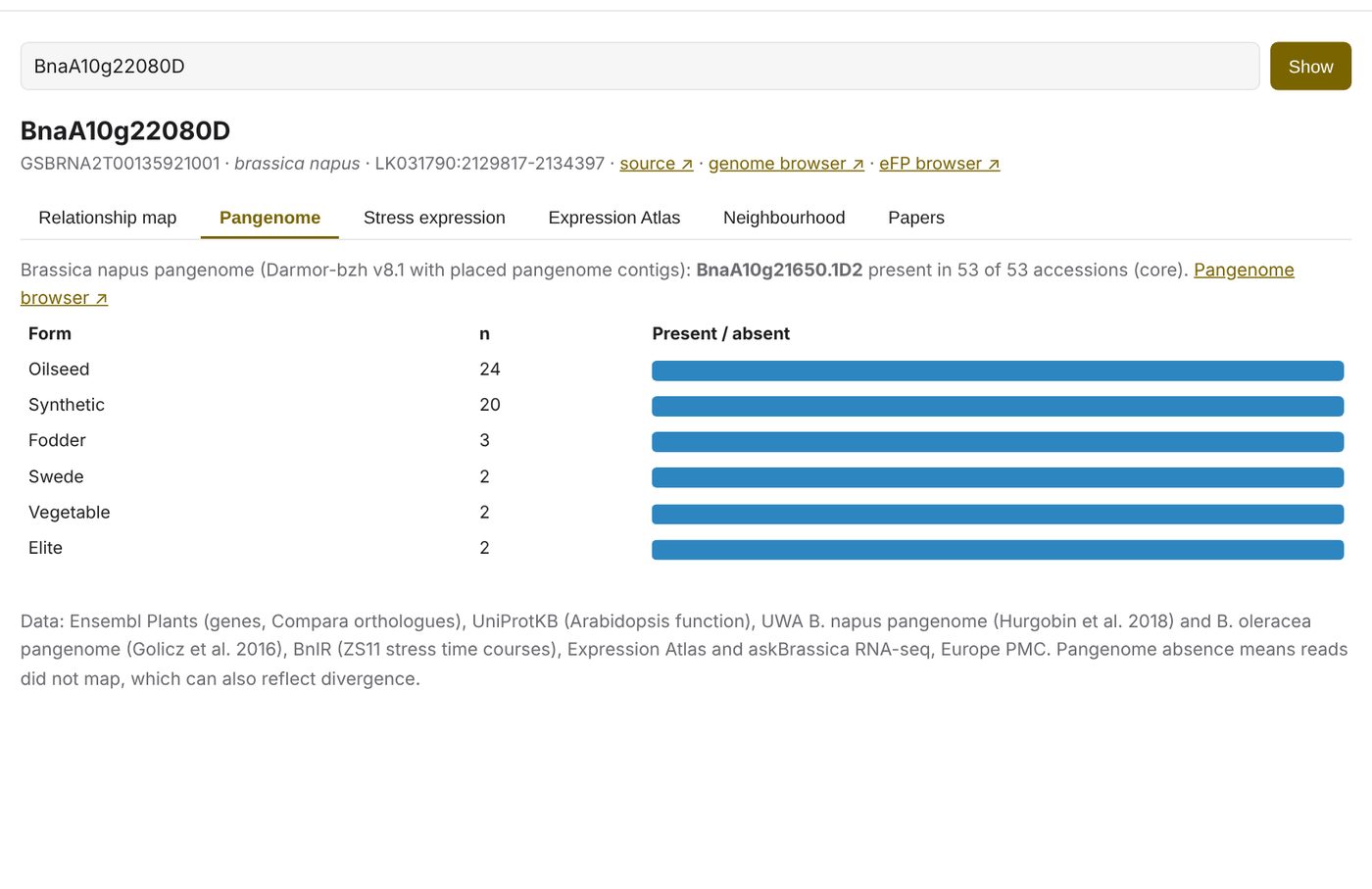 Pangenome tab on a gene page: presence by form (here the A10 FLC copy, a core gene present in all 53 accessions).
Try it
Which pangenome genes are much more common in the synthetic B. napus lines than in the oilseed lines? Give the top six with their frequencies and their Darmor and ZS11 IDs.
Tool called: pangenome_compare (group_a form:Synthetic, group_b form:Oilseed, min_diff 0.5).
1,897 genes differ in frequency by at least 0.5 between the 20 synthetics and the 24 oilseed lines. The top six are all novel pangenome genes (BnaPanG…) absent or nearly absent from oilseed:
| Gene | Synthetic | Oilseed | Present in (of 53) | Matching gene |
|---|---|---|---|---|
| BnaPanG004520 | 85% | 0% | 19 | Darmor v4.1 BnaC01g20680D; ZS11 BnaA05G0329800ZS |
| BnaPanG003527 | 85% | 0% | 18 | none |
| BnaPanG002144 | 90% | 8% | 23 | none |
| BnaPanG002421 | 85% | 4% | 21 | none |
| BnaPanG005886 | 85% | 4% | 21 | none |
| BnaPanG007045 | 80% | 0% | 19 | none |
What to take from it. Resynthesised lines carry genes the oilseed pool has lost, but the groups are small and related, so these are leads, not associations; the tool says so. Follow up with "What are these genes similar to in Arabidopsis, and are any expressed in seed?" (arabidopsis_function, gene_expression). Absence in the pangenome means reads did not map, which can also reflect divergence.
2. From a GWAS peak to a gene (erucic acid on A08)
BnIR holds 135 GWAS traits from 10 studies on the ZS11 reference; askBrassica stores their peaks with the lead SNP and the genes within 25 kb, and draws them on the trait map and in JBrowse on ZS11.
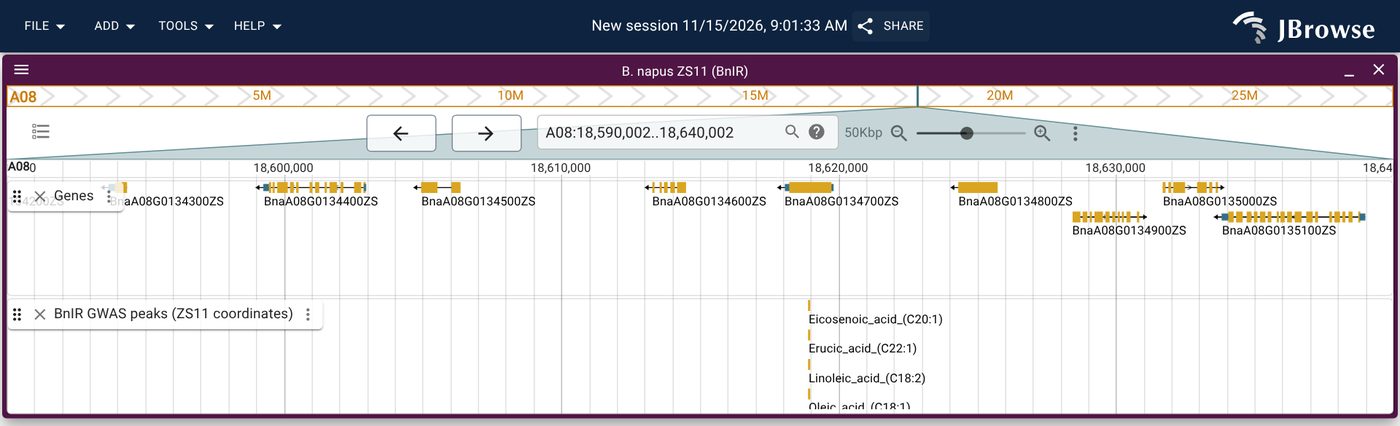 askBrassica JBrowse on ZS11 A08: the fatty-acid GWAS peaks sit on BnaA08G0134700ZS (FAE1).
Try it
Which BnIR GWAS peaks involve FAE1? For the strongest, give the lead SNP, its effect, the genes near it and a genome browser link.
Tool called: bnir_gwas (gene "FAE1").
Six peaks, all from Zhao et al. 2019 (doi:10.1111/pbi.13142) and all with the same lead SNP:
| Trait | Peak (ZS11) | p |
|---|---|---|
| Erucic acid (C22:1) | A08:16–21 Mb | 1.5 × 10⁻⁷² |
| Oleic acid (C18:1) | A08:16–21 Mb | 2.6 × 10⁻⁶⁸ |
| Eicosenoic acid (C20:1) | A08:17–20 Mb | 3.5 × 10⁻⁴⁸ |
| Palmitic acid (C16:0) | A08:17.5–20.5 Mb | 6.7 × 10⁻³⁰ |
| Linoleic acid (C18:2) | A08:17.5–20.5 Mb | 3.5 × 10⁻²⁷ |
For erucic acid the lead SNP is A08:18,618,888 (G/A), a missense variant inside BnaA08G0134700ZS, FAE1 (Arabidopsis AT4G34520; Darmor v4.1 BnaA08g11130D), explaining 22% of the variance (beta 14.6). Neighbours within 25 kb include KCS2, BHLH63 and SFH1.
What to take from it. The lead SNP falls in the gene whose loss gives low-erucic canola, and the same SNP drives the linked oleic and eicosenoic signals, as expected for one biochemical step. For a new peak, the same answer lists the candidate genes with Arabidopsis names, which is where to start. Positions are ZS11, not Darmor: ask for the Darmor ID before using Ensembl tools.
3. Checking seed lots and parents (Darmor, Tapidor)
CropSNPdb holds Brassica 60K genotypes of cultivars and controls, so two entries can be compared marker by marker. Two Darmor entries from different sources should be near-identical; Darmor and Tapidor should not.
Try it
Find Darmor and Tapidor in CropSNPdb, then compare the two Darmor entries on A01, A10 and C03, and Darmor with Tapidor on A10.
Tools called: snp_lines, snp_compare_lines.
snp_lines finds two Darmor entries (N021, from Poland, and Control_napus_18) and Tapidor (Control_napus_14).
| Comparison | Chromosome | Markers compared | Identical | Differing regions (Darmor v8.1, Mb) |
|---|---|---|---|---|
| Darmor N021 vs Control_napus_18 | A01 | 1,497 | 99.3% | 8.5–16.5 |
| Darmor N021 vs Control_napus_18 | A10 | 1,601 | 99.3% | 3.7–16.6, 25.4–31.4 |
| Darmor N021 vs Control_napus_18 | C03 | 2,912 | 96.9% | 0.3–11.6, 33.3–38.0, 67.3–70.9 |
| Darmor vs Tapidor | A10 | 1,599 | 83.7% | spread along the chromosome |
What to take from it. The two Darmor entries agree at 97–99% of markers, with a few blocks of difference, the signature of residual heterogeneity between seed lots rather than a mislabel; Darmor and Tapidor differ at 16% of A10 markers. Use the line names exactly as snp_lines returns them, and ask for the missing-call count with any comparison.
4. Resistance loci and genes (blackleg, clubroot)
askBrassica holds a curated table of resistance loci (from Vasquez-Teuber et al. 2024, doi:10.1007/s00122-024-04641-w, and others) with chromosome, source genotype, cloning status and gene ID, and finds resistance gene analogues (NBS, RLK, RLP, TIR) in any region of the pangenome.
Try it
List the blackleg resistance loci: chromosome, source genotype and whether cloned. Then list resistance gene analogues on A10 between 15 and 17 Mb and say which are variable across the pangenome.
Tools called: resistance_loci (pathogen "blackleg"), resistance_gene_analogues.
18 blackleg loci; 5 cloned:
| Locus | Chromosome | Source | Cloned gene |
|---|---|---|---|
| Rlm2 | A10 | Glacier | BnaA10g20720D, LRR receptor-like protein (allele of LepR3) |
| LepR3 | A10 | yes (same locus as Rlm2) | |
| Rlm4 | A07 | Jet Neuf | BnaA07g20220D |
| Rlm7, Rlm9 | A07 | yes | |
| Rlm1, Rlm3 | A07 | Quinta; Glacier, Maxol | not cloned |
| Rlm6, Rlm10 | B08, B04 | (from B. juncea / B. nigra) | not cloned |
A10 15–17 Mb (Darmor v8.1) holds 10 resistance gene analogues: 6 RLK, 2 TX (TIR domain only), 1 RLP, 1 NBS; 2 of them are variable (absent from some accessions). Clubroot gives 36 loci, almost all on A03 from B. rapa (CRa cloned, CRb, Rcr1, Rcr2 and others).
What to take from it. Most loci are mapped but not cloned, so the table gives a chromosome, not a gene: combine it with a region query for analogues, and with the variable flag, to shortlist candidates. B-genome loci come from B. juncea or B. nigra and have no B. napus gene.
5. How a gene responds to stress (FLC under freezing)
The Stress expression tab shows BnIR ZS11 time courses (cold, freezing, heat, drought, osmotic and salt, leaf and root, 0.25–24 h) as log2 change against the control sampled at the same time.
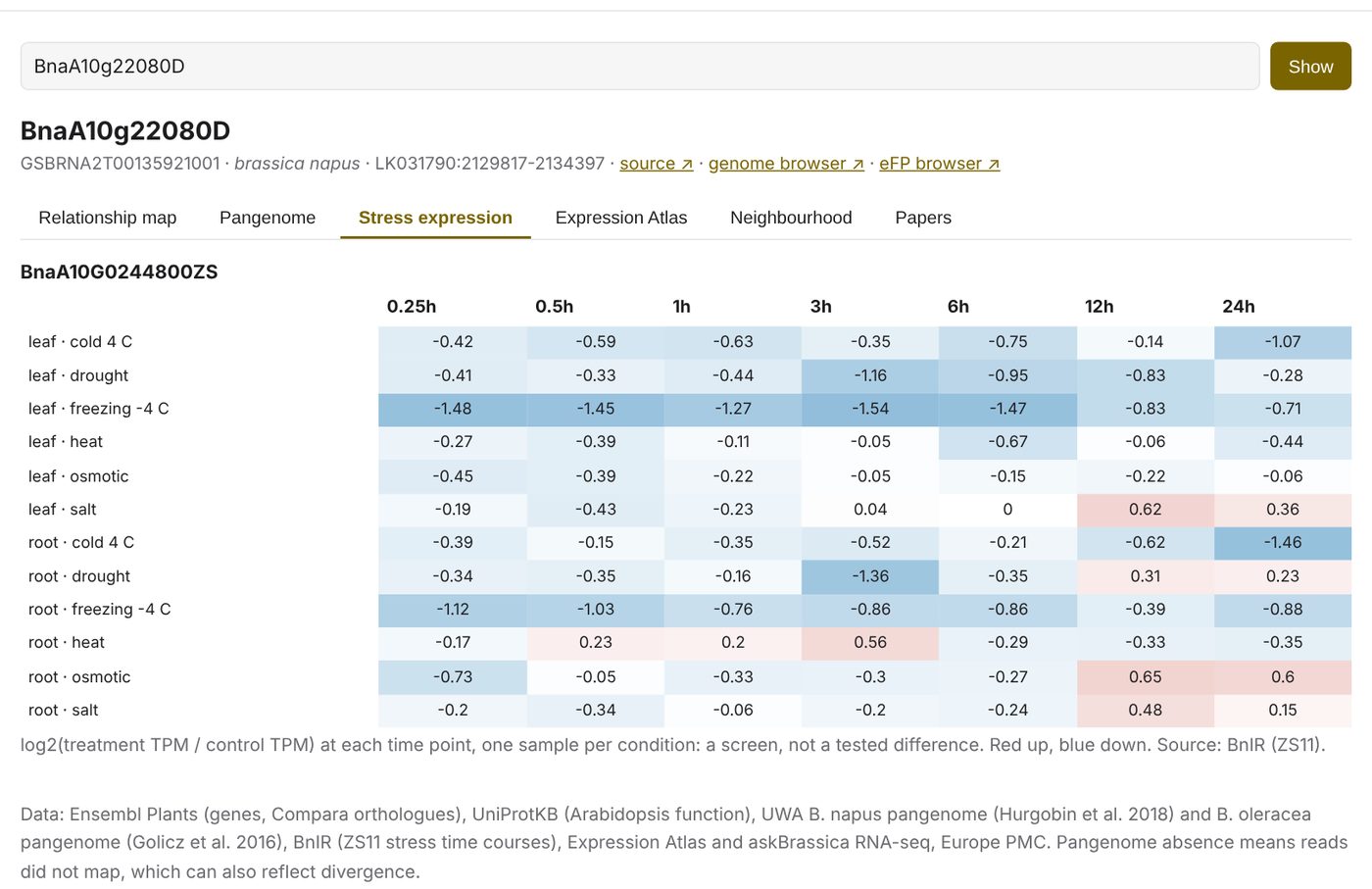 Stress expression for BnaA10g22080D (ZS11 BnaA10G0244800ZS): blue is down, red up, against the control at each time point.
Try it
How does the A10 FLC copy BnaA10g22080D respond to cold and freezing in BnIR? Give the strongest responses with TPM.
Tool called: bnir_expression.
The ID is bridged to ZS11 BnaA10G0244800ZS. Strongest responses:
| Tissue | Treatment | Time | TPM (control) | log2 change |
|---|---|---|---|---|
| leaf | freezing −4 °C | 3 h | 7.4 (23.6) | −1.54 |
| leaf | freezing −4 °C | 0.25 h | 7.3 (22.2) | −1.48 |
| leaf | freezing −4 °C | 6 h | 7.4 (22.2) | −1.47 |
| root | cold 4 °C | 24 h | 3.5 (11.3) | −1.46 |
What to take from it. The copy drops about threefold within 15 minutes of freezing and stays down; salt hardly changes it. BnIR has one sample per condition, so read the heatmap as a screen, not a tested difference. For the other FLC copies ask "Show the same for all B. napus FLC copies": the assistant finds them through orthologues from Arabidopsis FLC.
6. Candidate genes by function, and their neighbourhood
The gene finder lists genes by domain, GO term or pathway (321 MADS-box and 419 NB-ARC genes in B. napus), and the Neighbourhood tab on a gene page shows whether its genomic context is conserved in B. rapa, B. oleracea, Camelina and Arabidopsis.
Try it
Is the neighbourhood of BnaA10g22080D conserved in B. rapa, B. oleracea, Camelina and Arabidopsis? Which gene is its orthologue in each?
Tool called: gene_neighbourhood (flank 6: the gene and 6 neighbours each side).
| Genome | Block | Conserved neighbours | Orthologue of the gene |
|---|---|---|---|
| B. rapa R-o-18 | A10 | 7 of 13 | not found in the block |
| B. oleracea | C9 | 4 of 13 | Bo9g173370 |
| Camelina sativa | 8 | 11 of 13 | Csa08g054450 |
| Arabidopsis | 5 | 11 of 13 | AT5G10140 (FLC) |
What to take from it. The A10 copy sits in a block collinear with Arabidopsis chromosome 5 around FLC, confirming it as a true FLC copy rather than a paralogue. Ensembl B. napus is scaffold-level, so the neighbourhood stops at the scaffold end; for chromosome-scale context use the pangenome or ZS11 tracks.
7. One gene across cultivar genomes and RNA-seq projects (FLC.A10)
askBrassica holds 32 more Brassica assemblies from BnaOmics (B. napus cultivars such as Darmor-bzh v10, Westar, Tapidor, Quinta and ZS11; B. rapa, B. oleracea, B. juncea, B. nigra, B. carinata), each with its genes matched to Ensembl, and 69 B. napus RNA-seq projects from BrassicaEDB. Each assembly also has a genome browser and BLAST databases.
Try it
Find the A10 FLC copy BnaA10g22080D in the other B. napus genomes. Which matches are on A10, and in which RNA-seq projects is it most highly expressed?
Tools called: gene_in_assemblies, gene_expression.
| Assembly | Gene | Chromosome | Identity (%) | Reciprocal best hit |
|---|---|---|---|---|
| Darmor-bzh v10 | A10p27400.1_BnaDAR | A10 | 99.5 | yes |
| Quinta (HZAU) | BnaA10G0237000QU | A10 | 99.5 | yes |
| Laurentian (ONT) | LT_ONTA10g0023810 | A10 | 99.5 | yes |
| Westar (HZAU) | BnaA10G0239700WE | A10 | 100 | no (the C09 homoeologue is) |
| Tapidor (HZAU) | BnaA10G0238100TA | A10 | 82.7 | no |
Highest expression among BrassicaEDB projects: resynthesised AC / AAC dosage lines (PRJNA322687, about 2,990 TPM), Pi-starved seedlings (PRJNA401348, about 2,760 TPM); 57 projects in all.
What to take from it. The A10 copy is found on A10 in 11 assemblies. In several, the reciprocal best hit is the C09 homoeologue instead, and the tool flags such matches with other_chromosome. Tapidor's lower identity (82.7%) is worth a look in the genome browser before you call it a different allele. No match in an assembly with many broken gene models (ZS9, ZS4-2, the ONT genomes) can mean a disrupted model, not a missing gene; assembly_notes says when that applies. BrassicaEDB values are per-condition medians from public studies; compare them only within a project.
Prompts for an AI assistant, with visualisations
| Goal | Prompt | Picture you get |
|---|---|---|
| Pangenome | Which of these 20 canola genes are absent from the synthetic accessions? Show a presence/absence grid by form. | Gene × accession grid |
| GWAS | Plot all BnIR peaks for oil content on the chromosomes and list genes near each lead SNP. | Chromosome plot with peaks |
| Stress | Heatmap of BnIR drought and heat responses for the B. napus FAD2 copies. | Gene × time heatmap |
| Resistance | Map blackleg and clubroot loci by chromosome, coloured by cloned or not. | Chromosome diagram |
| Lines | Compare ATR-Banjo TT and ATR-Summitt on each chromosome; chart % identity. | Bar chart by chromosome |
| Orthologues | Find the B. napus, B. rapa and B. oleracea copies of Arabidopsis FAE1 and show their seed expression. | Table and bar chart |
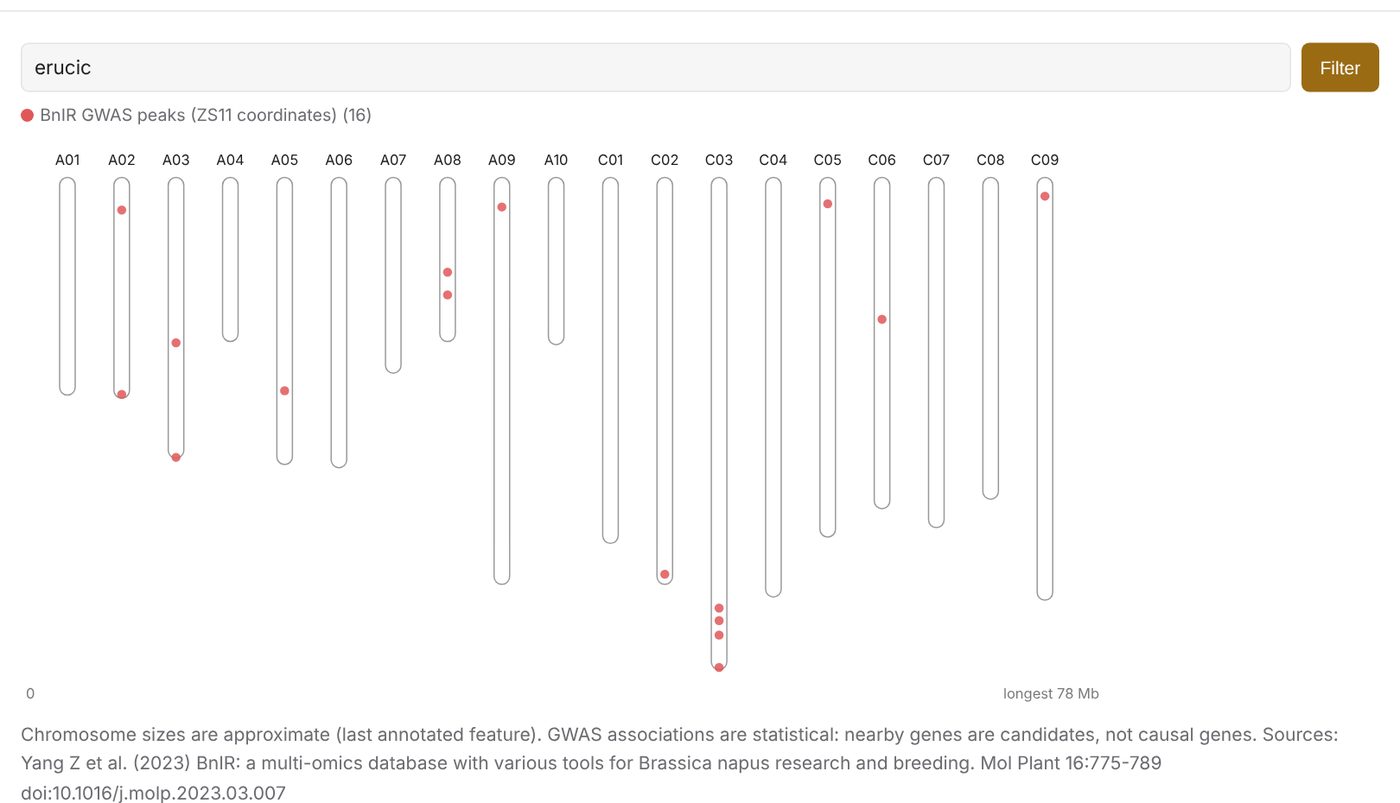 Trait map filtered by "erucic": 16 BnIR peaks on ZS11.
Before acting on a result
- Several coordinate systems are in use: Ensembl Darmor v4.1 (scaffold-level), pangenome Darmor v8.1, BnIR ZS11 and the 32 BnaOmics assemblies. Do not mix positions; convert gene IDs with the tools.
- Pangenome absence means reads did not map; it can reflect divergence as well as loss.
- BnIR stress expression has one sample per condition; GWAS peaks are associations, and genes near a lead SNP are candidates.
- Form comparisons in the pangenome use small, related groups and are exploratory.
Results shown were produced with askCrop tools in November 2026; numbers change as source databases update.